Most ACA reporting confusion starts with one question: does this apply to me? A 22-person company with a fully insured plan and a 22-person company with a level-funded plan get different answers, and plenty of small employers find out only after a penalty notice arrives.
Here is who files, what they file, and when.
Who Has to File ACA Reports
Two separate triggers pull an employer into ACA reporting. You only need to hit one.
Trigger 1: You are an Applicable Large Employer (ALE). An ALE averaged 50 or more full-time and full-time-equivalent employees during the prior calendar year. Cross that line in 2025 and you report for 2025 in early 2026, even if your headcount has since dropped.
Trigger 2: You sponsor a self-insured health plan, at any size. Size is irrelevant here. If the plan is self-funded, you report on every person enrolled in that coverage, whether you have 200 employees or 12. IRS forms are separate from the Department of Labor return, so it also helps to know when a health plan owes a 5500 on top of them.
That second trigger catches more small Colorado businesses than people expect, because level-funded plans are self-insured plans. They are sold as a middle ground between fully insured and self-funded, and they behave like fully insured coverage from a cash-flow standpoint. For reporting purposes they are self-insured, and the filing duty sits with you, not the carrier.
Fewer than 50 full-time equivalents and a fully insured plan? You generally have no employer filing obligation. The insurance carrier files Forms 1094-B and 1095-B covering the people enrolled in its plan. Other ACA rules still apply, including Summary of Benefits and Coverage and exchange notice duties, but the 1095 filing is not yours.
How to Count to 50 Correctly
The 50-employee test is not a headcount of badges in the building. It is a monthly average of two groups added together:
1. Full-time employees: anyone averaging 30 or more hours per week, or 130 hours per month. 2. Full-time equivalents: total the hours worked by everyone else in a month, cap each person at 120 hours, and divide that total by 120.
Add the two figures for each month, average the 12 months, and that sets your ALE status for the following year.
Two things trip up growing companies. Seasonal workers can be excluded in limited situations, when the workforce only exceeds 50 for four months or fewer during the year. And commonly owned businesses get aggregated.
One owner controlling three LLCs with 20 employees each may be looked at as all 60 together. Companies that grow by opening a second entity rather than a second location are the ones most likely to become an ALE without realizing it.
Worth flagging for Colorado employers: state insurance rules use their own definitions, and a “large employer” for state purposes is not the same threshold as a federal ALE. Our overview of Colorado employer benefits requirements walks through where the state definitions sit. Two rulebooks, two different numbers, and the federal 50-FTE test is the one driving your IRS filing.
Related readingACA & ERISA Compliance | Support for Colorado EmployersRead the guide →| Employer situation | Forms filed | Who is reported | IRS transmittal |
|---|---|---|---|
| ALE with fully insured plan | 1095-C | Full-time employees | 1094-C |
| ALE with self-insured plan | 1095-C | Full-time employees + enrolled individuals | 1094-C |
| Small employer with self-insured/level-funded plan | 1095-B | Individuals enrolled in coverage | 1094-B |
| Small employer with fully insured plan | Generally none | Carrier handles 1095-B reporting | Carrier files |
Which Forms You File
If you are an ALE, you file the C series:
- Form 1095-C goes to each full-time employee and to the IRS. It documents, month by month, whether you offered coverage, what the employee’s share of the lowest-cost self-only plan would have been, and whether the employee enrolled.
- Form 1094-C is the cover sheet that transmits your 1095-Cs to the IRS and reports your ALE status and full-time counts.
An ALE with a self-insured plan also uses Part III of the 1095-C to report enrollment for covered spouses and dependents.
If you are a small self-insured employer (under 50 FTEs, level-funded or self-funded), you file the B series instead: Forms 1095-B for enrolled individuals, with Form 1094-B as the transmittal.
The 1095-C is where audit exposure lives.
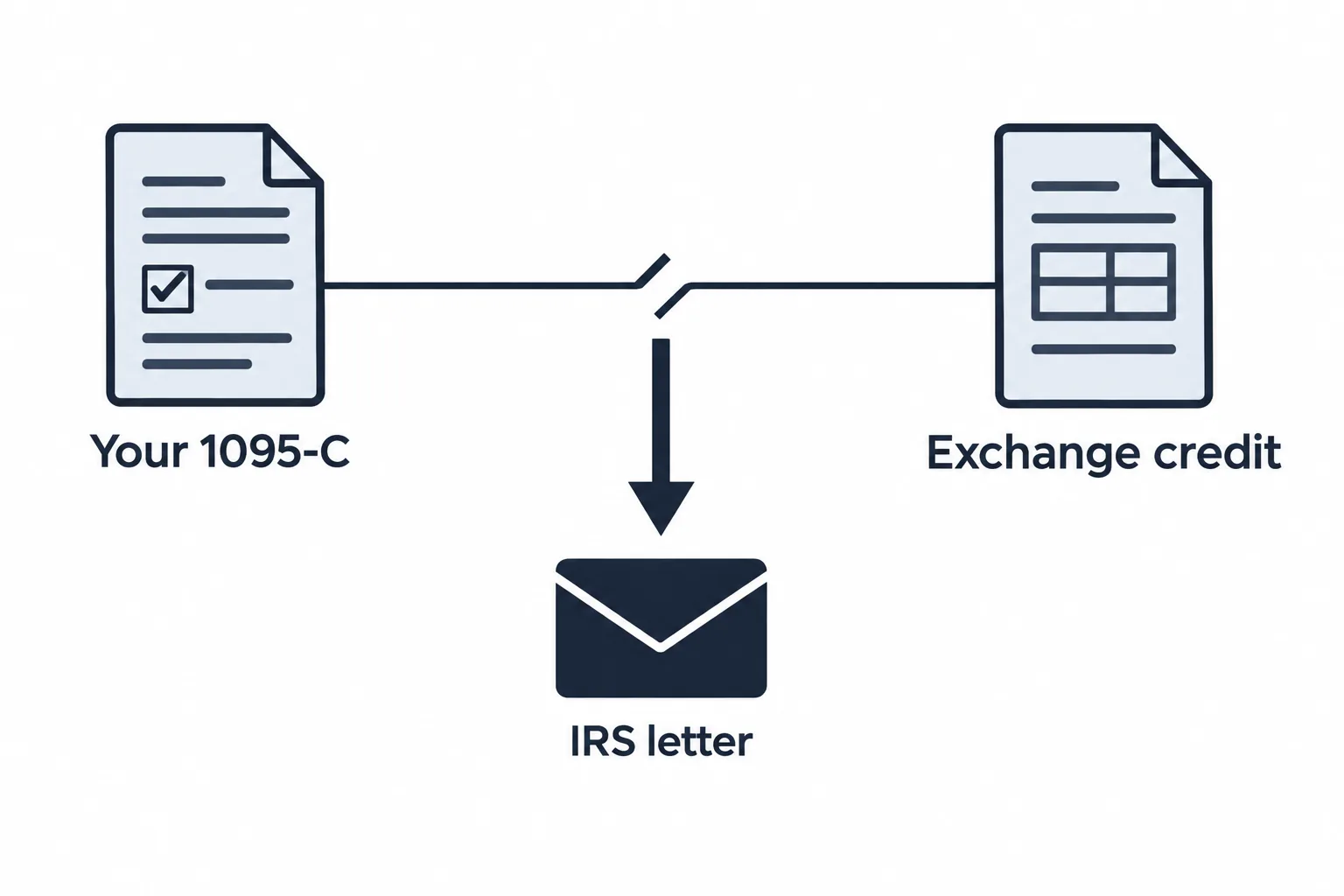
The coverage codes in Part II are what the IRS compares against marketplace subsidy data. If an employee received a premium tax credit through the exchange and your form says you offered affordable coverage, that mismatch generates a letter. Coding mistakes, not missing coverage, are behind a lot of employer penalty notices.
Deadlines and the E-Filing Rule
Three dates matter each year:
- Furnishing to employees: generally due by March 2, extended from the original January 31 date.
- Paper filing with the IRS: generally due by the end of February.
- Electronic filing with the IRS: generally due by March 31.
Exact dates shift when a deadline lands on a weekend or holiday, so confirm the current year’s calendar before you build an internal timeline.
| Requirement | General deadline | What the employer needs to do |
|---|---|---|
| Furnish forms to employees | March 2 | Provide 1095 forms, unless using the IRS alternative furnishing method |
| Paper filing with IRS | End of February | File applicable ACA information returns by paper |
| Electronic filing with IRS | March 31 | Electronically submit applicable ACA information returns |
| Electronic filing threshold | 10+ information returns | E-file when total information returns across applicable forms reaches 10 |
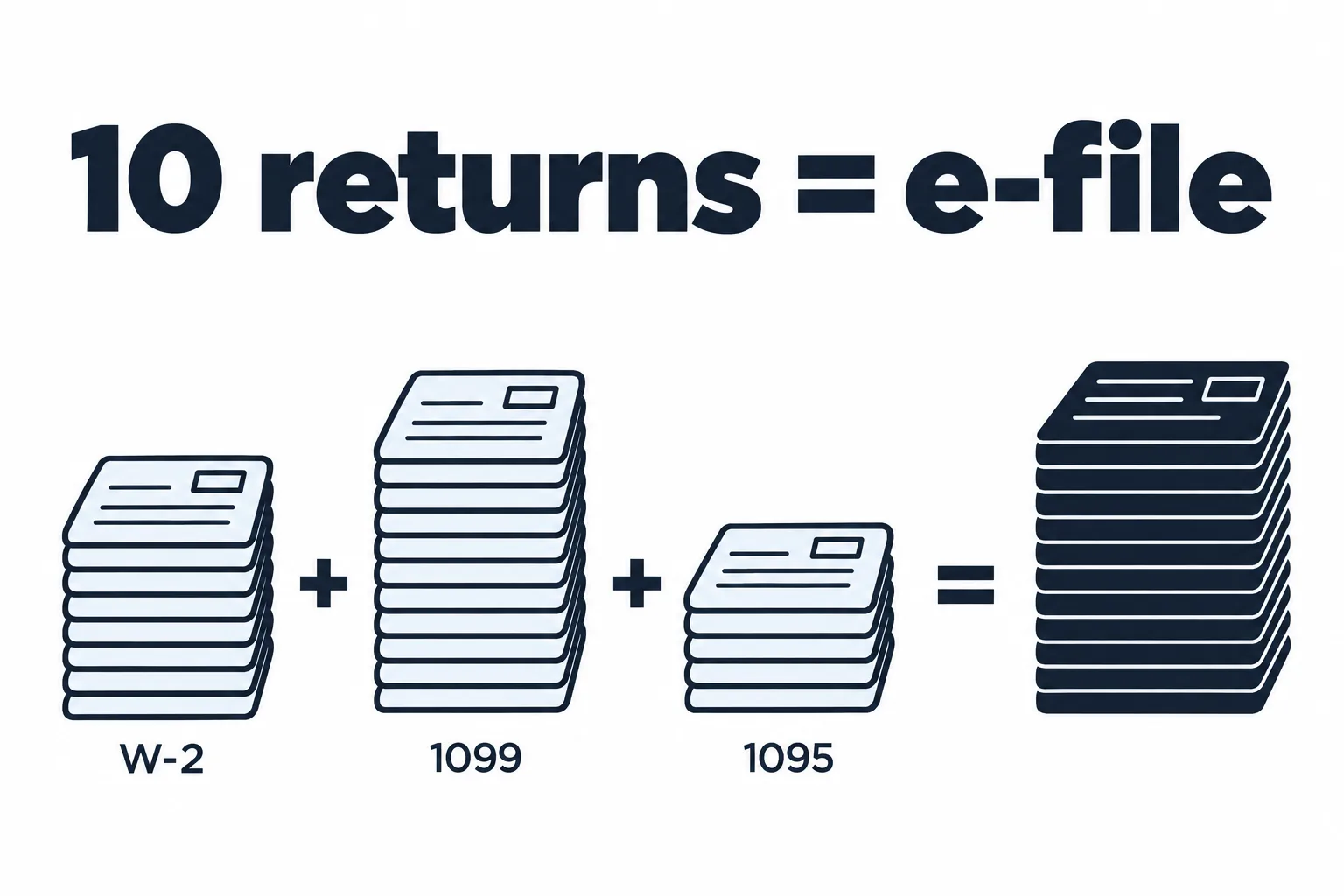
The e-filing threshold is the rule small employers get wrong most often. You must file electronically if you file 10 or more information returns in total. That count is an aggregate across form types: W-2s, 1099s, and ACA forms all add to the same 10. A 15-person company issuing 15 W-2s is already over the line, so paper filing is off the table even with a handful of 1095s.
What Changed for Furnishing Forms
Employers no longer have to automatically mail a 1095-C to every full-time employee. Under the Paperwork Burden Reduction Act, you can instead post a clear, accessible notice telling employees they may request their form, then deliver it within the required window once a request comes in.
The filing obligation to the IRS did not change. Only the automatic furnishing step did, and only if the notice is posted on time and somewhere employees actually see it. Get the notice wrong and you have simply failed to furnish.
State Reporting Adds a Second Layer
Several states run individual coverage mandates with their own forms and deadlines, including California, New Jersey, Rhode Island, and Massachusetts. Colorado is not one of them, so a Colorado business with a Colorado-only workforce deals with federal reporting alone.
Remote hiring changes that. Two employees living in California can pull you into California’s reporting regime even though your office is in Denver. Map where employees actually live before assuming federal filing is the whole job.
Where Employers Get Caught
- Treating a level-funded plan as if the carrier files for them. It does not.
- Missing ALE status because related entities were never aggregated.
- Using the wrong affordability safe harbor code, or applying one safe harbor to some employees and a different one to others without a consistent basis.
- Waiting until January to gather 12 months of hours data for variable-hour and part-time staff.
- Assuming a payroll vendor handles it. Many produce the forms only if you subscribe to that specific module, and accuracy still depends on the data you fed them all year.
That last one deserves emphasis. Your filing is only as good as your monthly tracking. Reporting is a January problem built out of twelve months of recordkeeping.
Build the Plan With Reporting in Mind
Most of the market renews in the fourth quarter, which makes Q4 the right time to look at this. Plan design and reporting burden are connected. Moving from fully insured to level-funded can lower cost and improve your data, and it also hands you a filing obligation you did not have before. Companies weighing a captive arrangement face a similar trade-off, and our captive funding explainer for midsize employers shows how those programs are structured. Fine trade, as long as you know it is coming and have the administrative support lined up.
For most brokers, the job ends when the paperwork is signed. At Cook & Associates it does not. We are an independent consultant, not a carrier’s sales channel, so we compare fully insured and self-funded options across multiple providers, negotiate on your behalf, and build around what your business is trying to accomplish. Then we stay involved: employee education meetings, claims and billing problems, ID card issues, and the compliance questions that surface in February.
For small groups, that ongoing support usually extends past medical. Dental, vision, life, and short- and long-term disability round out a package that competes for talent without a hospital system’s budget behind it.
Not sure whether your plan puts the filing duty on you or your carrier? That is a short conversation, and worth having before renewal season closes.