
Most business owners connect Form 5500 with 401(k) plans. Fewer realize that medical, dental, life, and disability coverage can carry the same annual reporting duty. Whether your company has to file comes down to three things: how many people are enrolled, how the plan is paid for, and how your benefits are organized on paper.
This guide covers those rules in plain language so you can tell whether a Form 5500 health and welfare plan filing applies to you, what it covers, and when it’s due.
What Is Form 5500 and Why Does It Matter for Health Plans?
Form 5500 is the annual report many employee benefit plans file with the federal government under ERISA, the law that governs most employer-sponsored benefits. It gives the Department of Labor (DOL) and the IRS a yearly snapshot of each plan: who sponsors it, how many people it covers, how it’s funded, and which insurance contracts sit behind it.
The point employers miss: health and welfare plans count. ERISA treats your group medical, dental, and life coverage as employee benefit plans, just like a retirement plan. A Form 5500 health and welfare plan filing can be required even if you never set up a 401(k).
Many small plans are exempt, but the exemption has conditions, and a growing business can cross the line without noticing. For a broader look at your obligations, see our ACA and ERISA compliance support for Colorado employers.
What Counts as a Health and Welfare Plan?
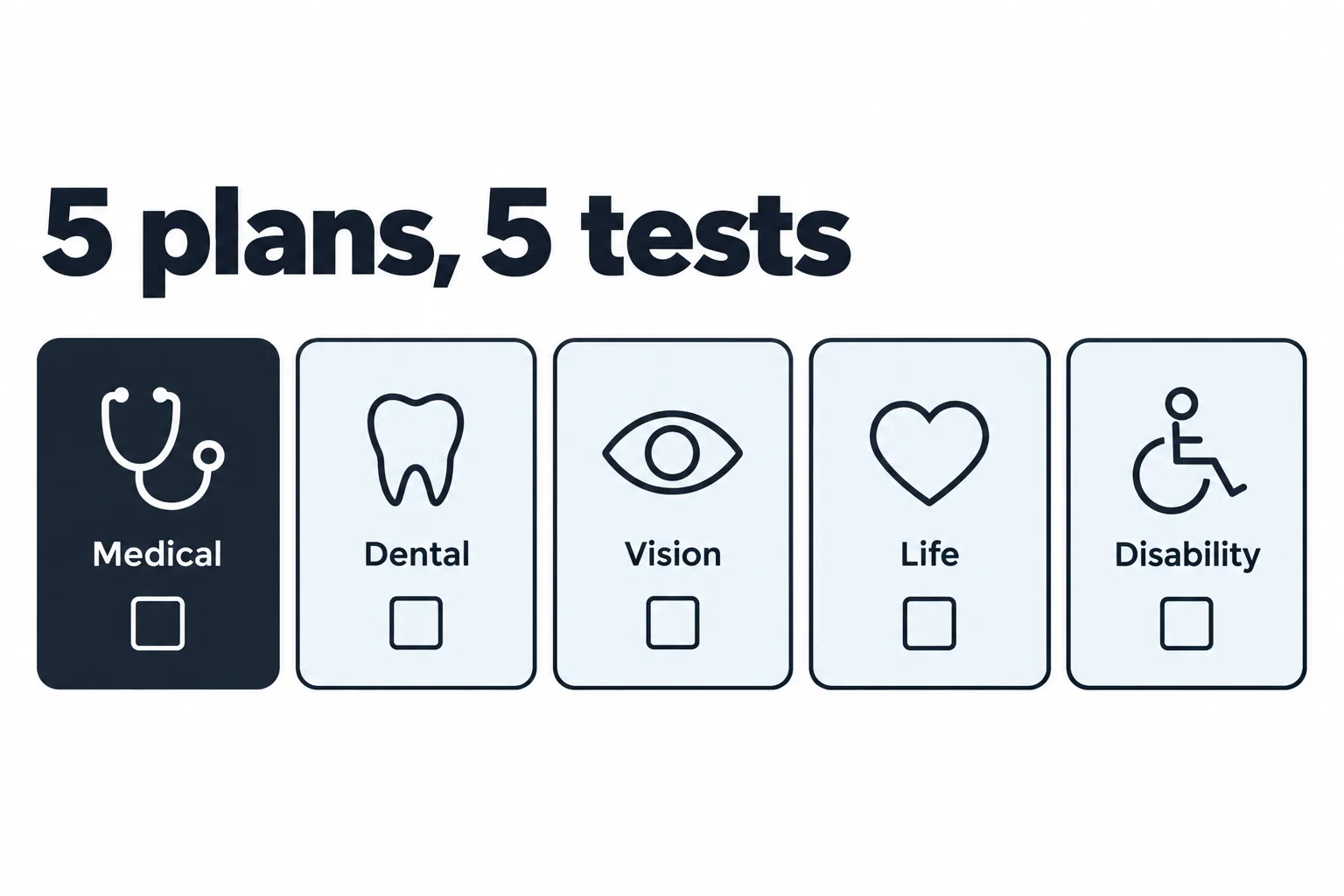
A health and welfare plan is any employer-sponsored program that provides benefits such as:
- Medical coverage
- Dental and vision coverage
- Group life and accidental death coverage
- Short-term and long-term disability
- Health flexible spending accounts (health FSAs)
- Health reimbursement arrangements (HRAs)
Health FSAs and HRAs are usually ERISA plans in their own right, while HSAs usually aren’t. Our HSA and FSA guidance explains the difference.
By default, each of these benefits is its own separate ERISA plan. Offer medical, dental, vision, life, and disability through different policies, and you may technically sponsor five plans, each tested separately under the Form 5500 health and welfare plan rules.
Some pay practices generally fall outside ERISA reporting, such as paying regular wages for sick days or vacation out of payroll. If you’re unsure whether a benefit counts, ask before you assume. You can see the full range of coverage we help employers build on our Colorado employer benefits page.
Who Is Required to File Form 5500 for a Health and Welfare Plan?
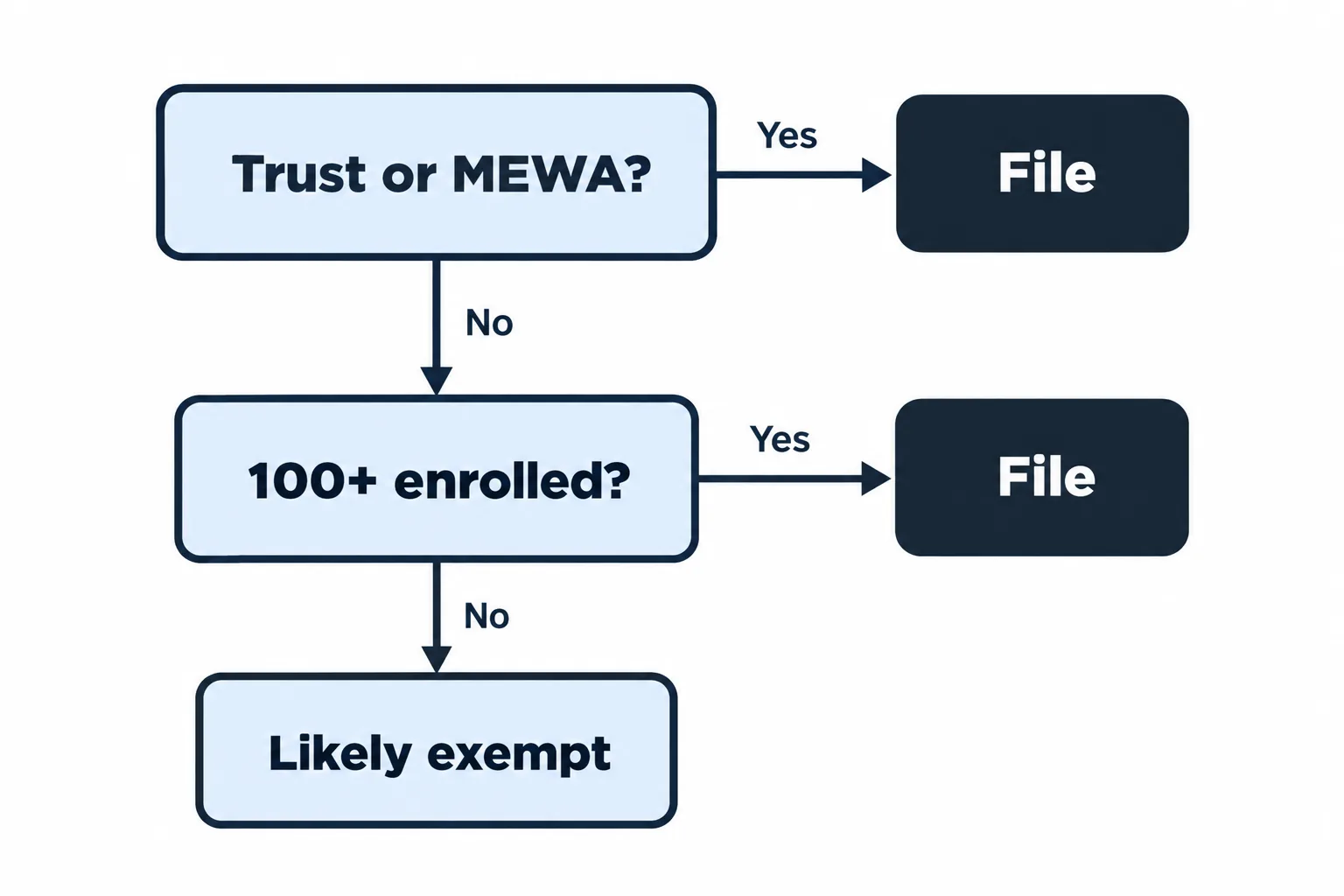
So who must file Form 5500 for health and welfare plans? The core rule: a plan with 100 or more participants on the first day of the plan year must file.
Plans with fewer than 100 participants usually qualify for the DOL’s small welfare plan exemption, as long as the plan is:
- Fully insured, meaning benefits are paid through a group insurance policy, or
- Unfunded, meaning benefits are paid directly out of the company’s general assets, or
- A combination of the two.
Two exceptions ignore size entirely. A plan must file regardless of participant count if it’s funded through a trust, or if it’s a multiple employer welfare arrangement (MEWA), a plan covering employees of more than one unrelated employer.
Wrangle 5500’s guide to health and welfare filings puts it simply: a group under a trust, or a MEWA that filed Form M-1, files no matter how many people are enrolled.
The test applies plan by plan. Your medical plan might have 110 participants and need a filing while your vision plan has 70 and doesn’t.
Medical is usually the first plan to reach 100, because it has the highest enrollment. See how we build group health insurance plans for Colorado employers.
Use this table to check each plan against the Form 5500 health and welfare plan filing rules.
| Plan situation | Participants on day one of plan year | File Form 5500? |
|---|---|---|
| Fully insured | Fewer than 100 | Generally no |
| Unfunded (paid from company assets) | Fewer than 100 | Generally no |
| Mix of insured and unfunded | Fewer than 100 | Generally no |
| Funded through a trust | Any number | Yes |
| MEWA that files Form M-1 | Any number | Yes |
| Level-funded | Fewer than 100 | Depends on how contributions are held. Check with your broker. |
| Any funding type | 100 or more | Yes |
How to Count Participants Correctly
The participant count decides everything, and it’s easy to get wrong:
- Count on the first day of the plan year. Not the year-end total, and not an average.
- Count people enrolled in the plan, not everyone on payroll. An employee who waives medical coverage isn’t a medical plan participant.
- Include the right groups. Mineral’s Form 5500 preparation tips confirm the count includes covered employees, retirees, and primary COBRA beneficiaries.
- Leave out dependents. An employee covering a spouse and two kids counts as one participant.
A quick example. A company with 75 employees has 60 enrolled in medical, well under the threshold. Add a handful of retirees and COBRA participants, a couple of years of hiring, or a decision to combine benefits into one plan (more on that below), and the count can reach 100 faster than expected.
Funding Matters: Insured, Self-Funded, and Level-Funded Plans
How your plan is paid for affects your Form 5500 health and welfare plan filing duty as much as headcount does.
- Fully insured plans pay a premium to a carrier, and the carrier pays claims. When these plans file, they attach a Schedule A with details on each insurance contract.
- A small self-funded health plan paid from company assets can still be exempt from Form 5500. Holding plan money in a trust is what removes the exemption.
- Level-funded plans blend the two. Depending on how contributions are held and paid, they can change your compliance workload.
That’s why funding decisions shouldn’t be made on price alone. A self-funded or level-funded arrangement can save money, but you want to understand the reporting side before you switch. We work with CFOs and financial decision-makers to compare fully insured, level-funded, and self-funded options, including the paperwork that comes with each.
Form 5500 vs. Form 5500-SF vs. Form 5500-EZ
You’ll see several versions in search results and the Form 5500 instructions. Here’s how they differ:
| Form | Who uses it | Used for health and welfare plans? |
|---|---|---|
| Form 5500 | The standard annual report, typically for large plans | Yes, the most common form for welfare plans that must file |
| Form 5500-SF | A shorter version for certain small plans that meet specific conditions | Sometimes, for small plans that must file |
| Form 5500-EZ | One-participant retirement plans, such as a plan covering only an owner | No |
Form 5500 Schedule A deserves its own mention. Insured welfare plans attach a Schedule A for each insurance contract, reporting information such as premiums and commissions. If medical, dental, and life come from different carriers, expect several. Carriers supply the information, but you usually have to ask for it.
Form 5500 Due Dates and Extensions
The Form 5500 health and welfare plan deadline follows your plan year, not the calendar year.
Per 5500tax’s overview of welfare plan filing issues, the form is due by the last day of the seventh month after the plan year ends, and filing Form 5558 buys up to two and a half more months.
Here’s the Form 5500 due date for welfare plans on a calendar plan year (January 1 to December 31):
- Regular due date: July 31 of the following year (the 2025 plan year is due July 31, 2026)
- Extended due date with Form 5558: October 15 of the following year
On a different plan year? Count seven months forward from its end date.
Not on a calendar plan year? Find your plan year end below.
Related readingACA Reporting Requirements for Employers (2026)Read the guide →| Plan year ends | Regular due date | Extended due date (with Form 5558) |
|---|---|---|
| December 31, 2025 | July 31, 2026 | October 15, 2026 |
| March 31, 2026 | October 31, 2026* | January 15, 2027 |
| June 30, 2026 | January 31, 2027* | April 15, 2027 |
| September 30, 2026 | April 30, 2027 | July 15, 2027 |
This is where fourth-quarter renewal season matters. Many employers renew in the fall, and renewal is the right moment to confirm your plan year, your participant counts, and which benefits need a filing, rather than finding out the following summer.
How to File Form 5500
If a plan needs to file:
- File electronically. Form 5500 is submitted online through the DOL’s EFAST2 system. Paper filings aren’t accepted.
- Gather plan basics. You’ll need the plan year dates, your company’s EIN, the three-digit plan number for each plan, and the participant count from the first day of the plan year.
- Request Schedule A information from each carrier. Ask early. Carrier reports can take time.
- Use the correct codes. The form asks how the plan is set up and how benefits are funded and paid. Wrong codes are among the most common errors.
- Check before submitting. The filing must be properly signed and dated, use the correct EIN and plan number, and cover no more than 12 months.
Filed reports are public. Anyone can look up a plan’s filings through the DOL’s Form 5500 search, which is also an easy way to check what your company filed in past years.
Bundling Benefits Into One Filing With a Wrap Plan Document
Because each benefit is a separate plan by default, a company that must file could end up with several Form 5500s a year: one for medical, one for dental, one for life, and so on.
A wrap plan document combines multiple welfare benefits into a single ERISA plan. The result:
- One Form 5500 for all included benefits
- A Schedule A for each insured benefit, attached to that single filing
- A cleaner way to meet ERISA’s requirement for a written plan document and summary plan description (SPD), which insurance certificates often don’t fully satisfy on their own
The tradeoff: once benefits are combined, participants are counted across the whole plan. Someone enrolled only in life insurance and someone enrolled only in medical both count toward the same total. Three separate plans under 100 can become one combined plan over 100, with a new filing requirement.
This matters most for group life and disability coverage, which often has higher enrollment than medical because it’s cheap or fully employer-paid.
That doesn’t make wrap documents a bad idea. For many employers the cleaner paperwork is worth it. Just make the decision with the participant math in front of you.
What Happens If You Miss a Filing?
Late or missing filings can get expensive. The DOL can assess civil penalties that accrue daily, and IRS penalties may apply too, so a gap left alone for a few years grows quickly.
The DOL’s Delinquent Filer Voluntary Compliance Program (DFVCP) lets plan administrators catch up on missed filings at reduced penalties if they come forward before the DOL contacts them. If you find a gap, address it sooner rather than later.
The mistakes we see most often:
- Counting the wrong people, such as including dependents or using year-end numbers
- Missing Schedule A forms for one or more insurance contracts
- Using the wrong plan number or changing it from year to year
- Assuming the carrier filed. Carriers provide Schedule A information, but they generally don’t file Form 5500 for you. The plan sponsor (your company) is responsible.
How Cook & Associates Helps Colorado Employers Stay Compliant
Form 5500 is a good example of why your broker shouldn’t disappear after renewal. The deadline lands months after open enrollment, and the information you need comes from carriers, payroll, and plan documents spread across the year.
We work for your business, not an insurance company. As an independent consultant, we:
- Map your filing picture, including which plans may need a Form 5500 and where your participant counts stand
- Help gather Schedule A information from carriers so you aren’t chasing paperwork in July
- Advise on plan structure, including whether a wrap document makes sense for your benefits
- Compare funding strategies across multiple carriers, from fully insured to level-funded and self-funded, with compliance in view
- Stay involved year-round, helping employees use their benefits, stepping in on claims and billing issues, and answering day-to-day questions
Too many benefit plans are built around a carrier’s template. We build yours around your goals and keep it performing after the paperwork is signed. Heading into renewal season? Review your coverage and your compliance together, and visit our ERISA compliance support page to start a better benefits strategy.