
Group captive health insurance is what happens when several employers stop buying health coverage as customers and start owning part of the risk themselves. For some Colorado companies it is a smart next step.
For plenty of others it is the wrong tool sold with a good story. The difference comes down to headcount, cash reserves, and how much plan management you want to take on.
What Group Captive Health Insurance Is
Several employers jointly own an insurance entity that covers a shared band of their medical claims. Each member still runs its own self-funded health plan and pays its employees’ claims up to a set dollar threshold.
The captive sits above that threshold and below catastrophic coverage bought from an outside insurer. It is a middle layer, not a replacement for your health plan.
The shift is ownership. Members are owners, not policyholders. Money that would normally stay with a carrier in a good year can come back to the group. You will hear the same structure called a group captive, a medical stop-loss captive, or a pooled self-funded arrangement.
How the Money Flows
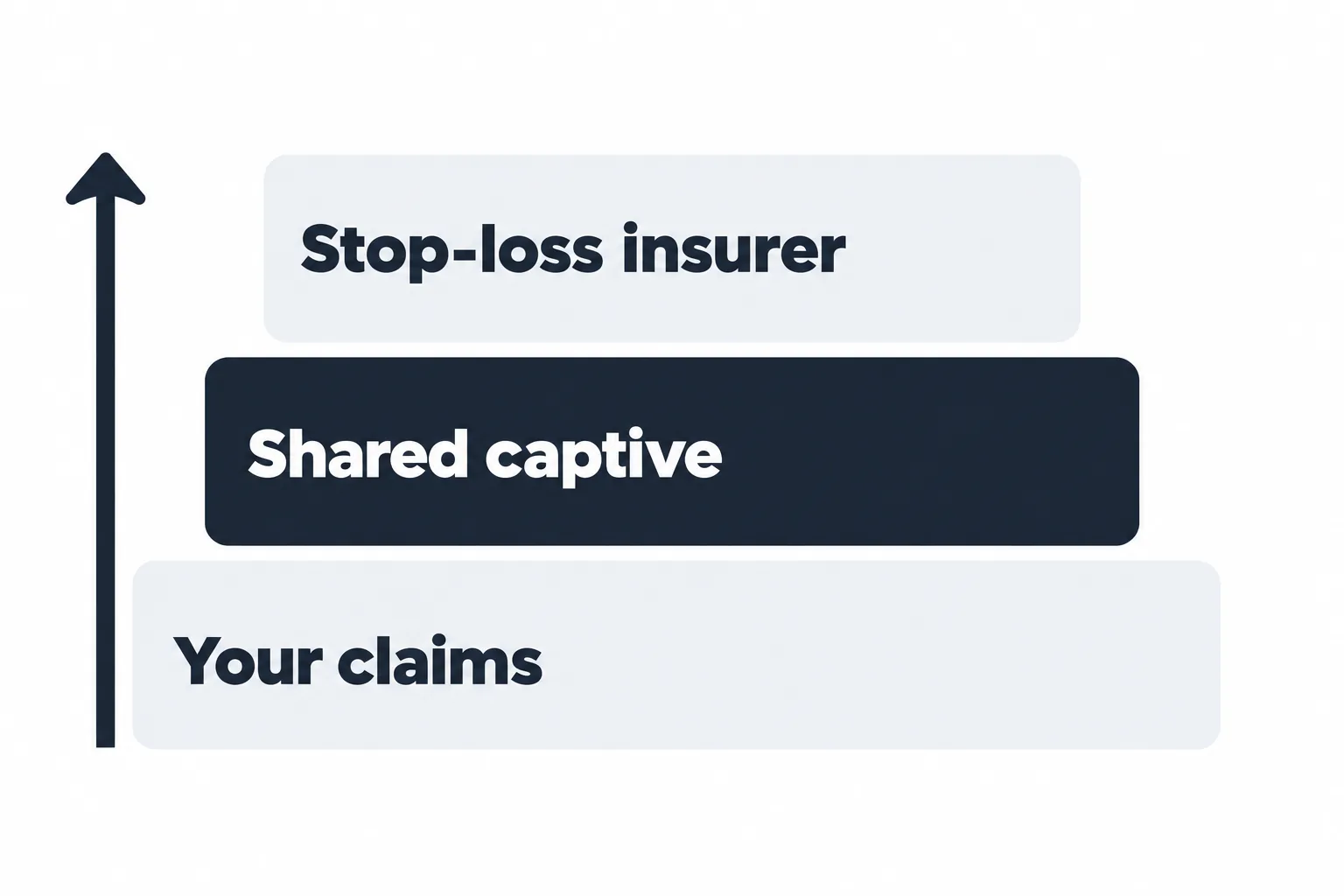
- Your claims account. Everyday medical and pharmacy claims come out of employer funds, up to your threshold.
- The shared captive fund. Claims above that threshold hit the pooled layer all members fund together.
- Outside coverage. The largest claims sit above the captive layer with a commercial insurer, which caps your worst case.
Fixed costs run under all of it: plan administration, network access, stop-loss premium, captive management, consulting fees. A good claims year can return a surplus or lower next year’s contributions. A bad one can mean extra assessments.
What Employers Actually Gain
- Steadier renewals. One catastrophic claim gets absorbed by the pool instead of landing entirely on your renewal.
- You see your data. Self-funding shows what drives cost: specialty drugs, imaging, chronic conditions. A fully insured renewal hides that.
- Plan design freedom. Build benefits around your workforce instead of picking from packaged options.
- A screened pool. Captives underwrite who gets in, so you share risk with employers who manage it.
The Costs Nobody Advertises
You put up capital or collateral to fund your share of the risk layer. That money is committed, not available for payroll.
Captives are a multi-year commitment. Leaving after one rough year is usually expensive or limited by the member agreement. Cash flow changes shape too: claims arrive unevenly, so your monthly outlay stops being a flat premium you can drop into a budget line.
Self-funding also makes you the plan sponsor, with real compliance and oversight duties. Ask for every fee itemized. Bundled administration, captive management, and consulting fees are where cost quietly stacks.
One example is the annual gag clause prohibition compliance attestation. Your TPA can submit it, but the responsibility stays with you.
Captive vs Fully Insured vs Level Funded vs Self-Funded
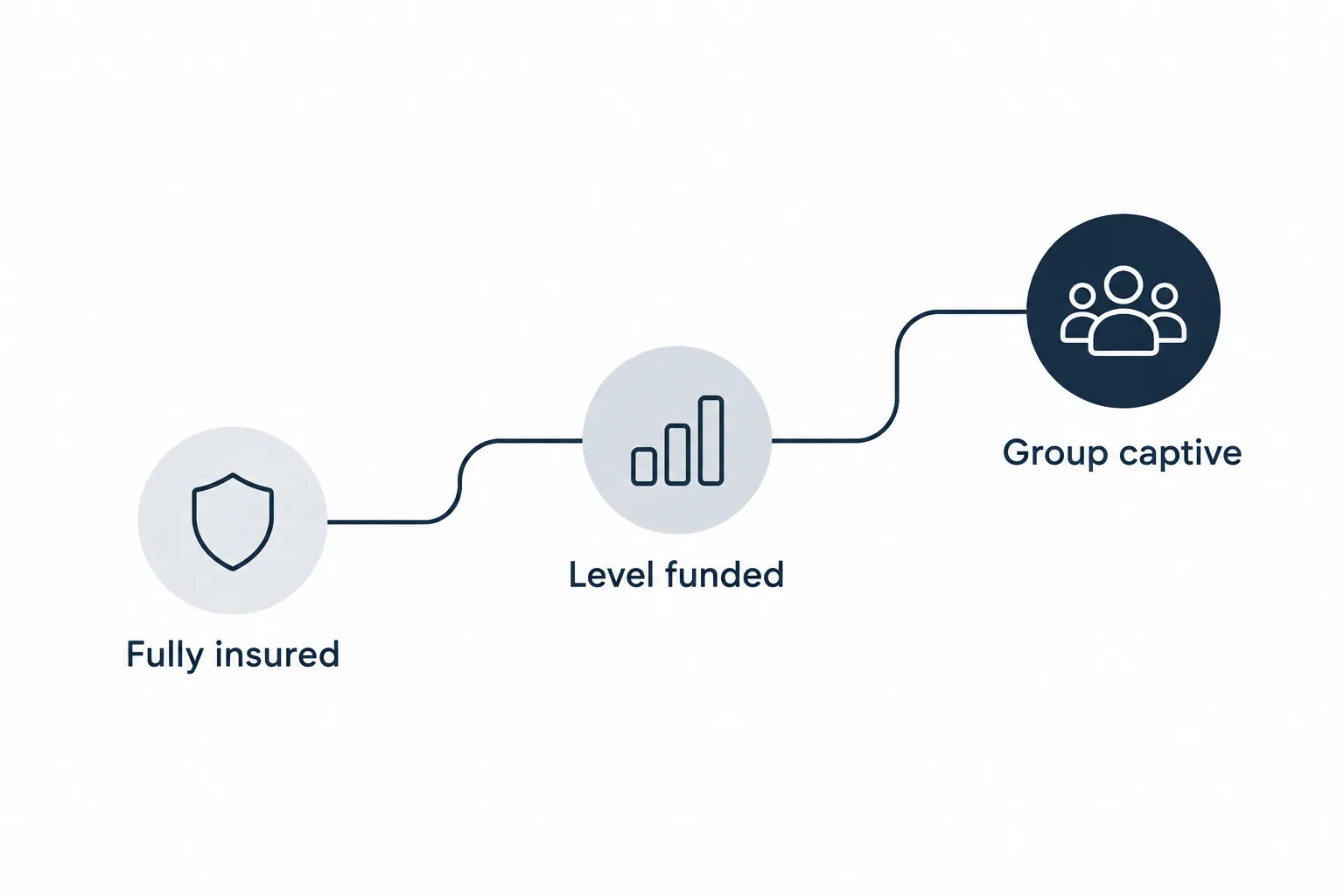
Fully insured: fixed premium, carrier keeps any surplus, little data, lowest workload.
Level funded: a fixed monthly payment with a possible refund if claims run low. The most common first step out of fully insured, and the right answer for many small groups.
Standalone self-funded: full control, full volatility, catastrophic coverage priced on your risk alone.
Group captive: self-funded control with the volatility shared and the surplus kept by members.
What decides whether group captive health insurance fits: group size, cash reserves, claims history, risk tolerance, and whether leadership will act on what the data shows.
Here’s how the four funding models compare.
| Fully insured | Level funded | Standalone self-funded | Group captive | |
|---|---|---|---|---|
| Monthly cost | Fixed premium | Fixed payment | Changes with claims | Changes with claims |
| Who keeps the surplus | Carrier | You may get part back | You | Members share it |
| Who carries claims risk | Carrier | Mostly the carrier | You, up to stop-loss | You, then the pool, then stop-loss |
| Claims data you see | Little | Some | Full | Full |
| Your workload | Lowest | Low | High | High |
| Usually fits | Groups that want a predictable cost | Small groups leaving fully insured | Large groups with strong cash reserves | Mid-size groups that meet the pool’s minimum enrollment |
Is Your Colorado Business Big Enough for a Captive?
For most small employers, group captive health insurance isn’t the right fit yet. Captive programs set minimum enrollment counts, and small groups usually sit below them.
If you are under that line, the productive moves are level funded plans, ICHRA and HRA strategies, and tighter network design. Our guide to ICHRA vs group health insurance shows which model fits smaller teams.
Those build a track record so a captive becomes a live option as you grow. Signals you are getting close: stable enrollment, healthy cash reserves, and leadership willing to change plan design based on claims data.
Whichever model you land on, dental, vision, life, and short- and long-term disability still need coordinated design. Those pieces shape how employees feel about the whole package.
What to Ask Before Renewal
Most of the market renews for the next plan year in the fourth quarter, so feasibility work starts months ahead.
Ask for thresholds, collateral requirements, assessment terms, exit provisions, and an itemized fee schedule. Request the pool’s loss history and how many members have left. Then model two bad claims years in a row, not just the savings illustration you were handed.
Get these answers in writing before you sign:
| Ask about | Why it matters |
|---|---|
| Your claims threshold | Sets how much of each claim you pay before the pool steps in |
| Collateral requirement | This cash is locked up and can’t be used for payroll |
| Assessment terms | How much extra you could owe after a bad year |
| Exit provisions | What leaving costs, how run-out claims are handled, and when collateral comes back |
| Itemized fee schedule | Administration, captive management and consulting fees often hide in bundles |
| Pool loss history and member turnover | Shows how the pool performs and whether members stay |
| Two bad claims years in a row | Tests whether your cash can absorb the downside, not just the savings illustration |
That review is where an independent consultant earns their keep. Cooke & Associates compares fully insured and self-funded options across multiple carriers, negotiates on your behalf, and stays involved after the paperwork is signed: onboarding, employee education meetings, claims and billing problems, and the questions that come up all year.