
Most renewal conversations in Colorado’s small group market come down to one number: the increase. Reference-based pricing health plans are one of the few strategies that change how a plan pays for care instead of moving more cost onto employees. It also carries a real trade-off, and you deserve to hear it before you sign anything.
What a reference-based pricing health plan is
A reference-based pricing (RBP) health plan sets a firm ceiling on what the plan will pay for a medical service. Your plan document decides the price instead of accepting the hospital’s billed charge or a carrier’s negotiated discount off that charge.
The “reference” is almost always Medicare. Medicare publishes what it pays for each service in each part of the country, so the plan uses that figure as a yardstick and pays a set multiple of it.
Compare that with a PPO, where the carrier’s network contract sets the price and the employer pays whatever the contract says. RBP is not a different kind of insurance company. It is a cost-control method used inside self-funded and level-funded plans, and it moves pricing decisions to the employer.
How reference-based pricing actually works
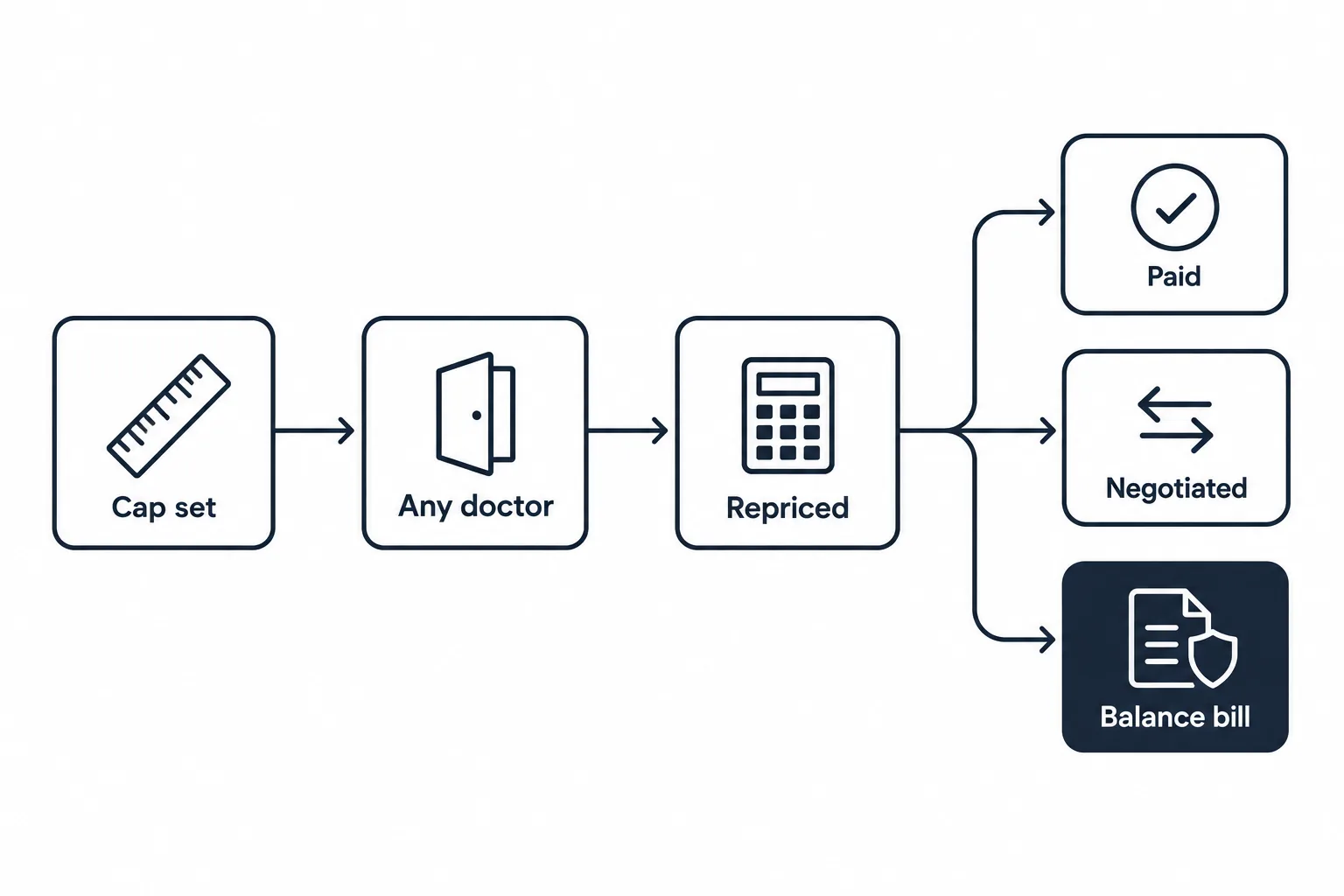
| Step | What happens | What to watch |
|---|---|---|
| 1. Cap tied to Medicare | The plan pays a set multiple of Medicare, typically 120% to 300% | The multiple varies by vendor and type of care |
| 2. No PPO network | Employees can use any provider willing to accept the payment | The network’s protection against balance billing is gone, unless the program is a hybrid |
| 3. Administrator reprices the claim | A third-party administrator or pricing vendor calculates the allowed amount and pays the provider | Vendor quality varies widely |
| 4. Provider accepts, negotiates, or bills the member | Most claims close quietly, some are negotiated, a few end in a balance bill | Strong programs include patient advocacy and legal defense |
Step 1: The plan sets a cap tied to Medicare
The plan document names a multiple of Medicare as the allowed amount, typically between 120% and 300% of the Medicare rate depending on the vendor and the type of care. Inpatient stays, outpatient procedures, and physician services often carry different multiples. The multiple sits above Medicare on purpose, so the provider still earns a margin.
Step 2: There is no traditional PPO network
Employees can generally use any provider willing to accept the plan’s payment. There are no in-network or out-of-network tiers, so the penalty that catches people traveling or seeing a specialist disappears.
The trade-off matters. A network contract is also what normally stops a hospital from billing the patient for whatever the plan did not pay. Without it, that protection has to come from somewhere else. Some programs are hybrid: they keep a network for doctors and apply RBP only to hospital and facility bills, where the largest dollars sit.
Step 3: A third-party administrator reprices the claim
A third-party administrator (the firm that processes claims for a self-funded plan) or a specialty pricing vendor receives the bill, calculates the allowed amount, and pays the provider. The same vendor issues ID cards, answers member calls, and fields provider questions.
Hospitals keep a master list of charges that has little to do with what care costs. An RBP plan ignores that list and prices from Medicare instead.
Step 4: The provider accepts, negotiates, or bills the member
Many claims close without the employee hearing anything. Some providers come back and negotiate a settlement above the first payment, which the vendor handles. A few refuse and send the patient an invoice for the unpaid balance. That is balance billing, and it is the complaint you will hear most about these plans. Strong programs include patient advocacy and legal defense so the employee is not the one arguing with a billing office.
Why hospital pricing makes this strategy work
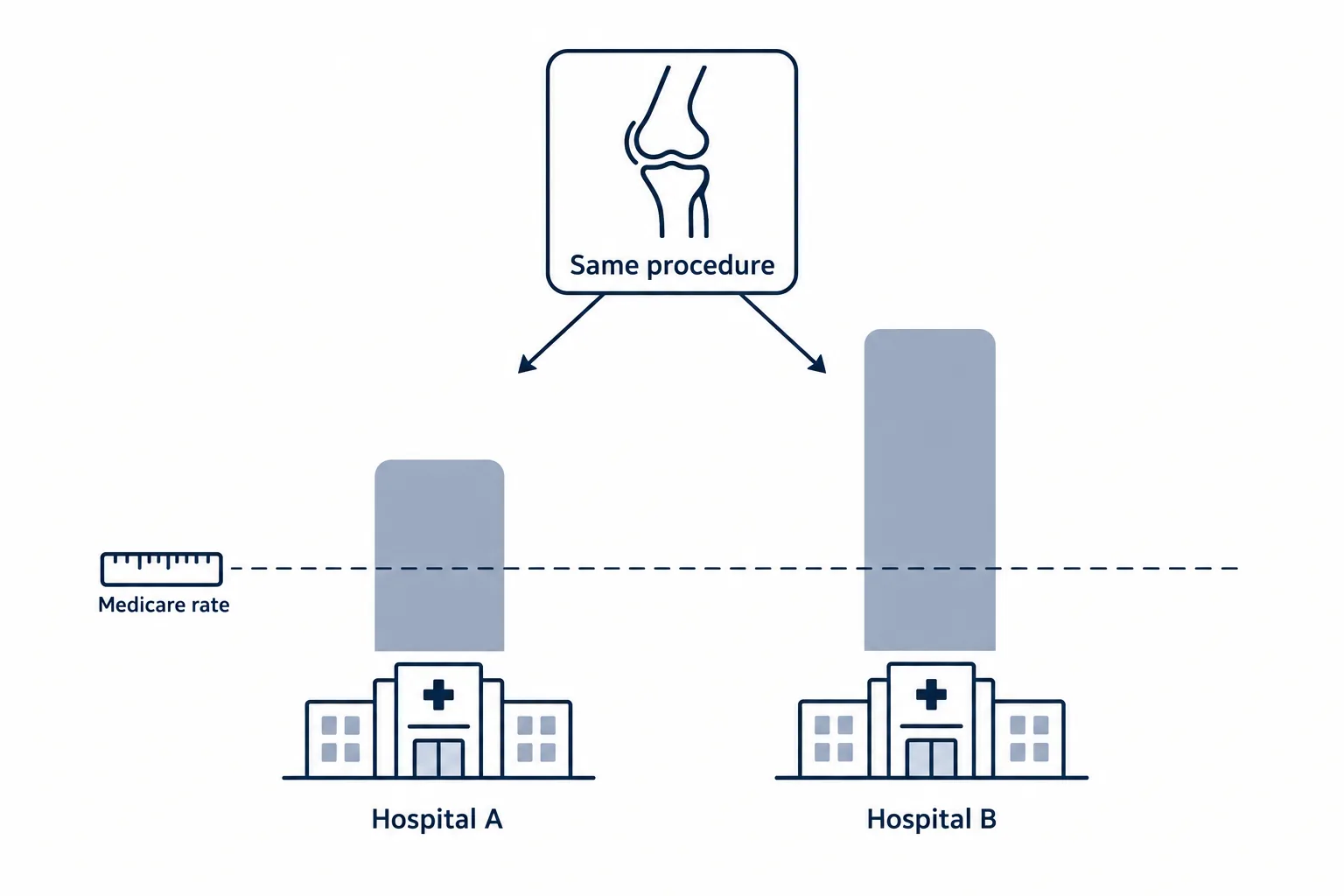
The same procedure at two hospitals in the same metro area can carry very different prices, and the price often depends more on who is paying than on the care delivered. Commercial health plans generally pay hospitals well above what Medicare pays for identical services.
Medicare rates make a workable yardstick because they are public, updated every year, and already adjusted for local wage and cost differences. An employer can point to a published number and explain exactly how a claim was priced. That is hard to do with a percentage discount off a charge nobody can verify.
Reference-based pricing health plans vs. a traditional PPO plan
| PPO | Reference-based pricing | |
|---|---|---|
| Who sets the price | The carrier’s network contract | Your own plan document |
| Where savings come from | A discount off an inflated charge | A cap tied to an outside benchmark (Medicare) |
| Member experience | Network directory and predictable cost sharing | Open access, with possible friction at the billing desk |
| Renewal math | A trend increase applied to premium | Spend that follows your actual claims |
| HR workload | Lower | Higher, especially in year one |
The advantages for employers
- Lower spend on hospital and facility claims, which drive most small group renewals.
- Full visibility into how every claim was priced.
- No network restrictions, so employees keep their own doctors and hospitals.
- Savings stay in the plan instead of funding a carrier’s margin.
- Freedom to adjust multiples, carve-outs, and benefits each year rather than picking from a menu.
The risks nobody should gloss over
Balance billing is the biggest drawback, and the one employees feel. Even when the vendor clears the bill, the employee has spent two weeks worried about it, and that story travels through a 25-person company fast.
Some hospital systems push back harder than others, occasionally declining to schedule non-emergency care or asking for payment up front.
RBP only works when employees know what to do before they schedule a procedure and what to do if a bill arrives, which makes communication part of the plan rather than an afterthought. Vendor quality varies widely, and the advocacy and legal defense terms are where the difference shows. A poorly matched RBP plan is worse than an unremarkable PPO.
How balance billing risk gets managed
Related readingGroup Health Insurance vs. Individual CoverageRead the guide →| Safeguard | What it does |
|---|---|
| Member advocacy and legal defense | Written into the vendor agreement at no cost to the employee |
| One rule for employees | Never sign a financial responsibility form at the front desk without calling the plan first |
| Price agreed before scheduled care | Fixes the number in advance for imaging, scopes, and joint replacement |
| Written answer on billing protections | Confirms how federal and Colorado rules apply to your plan, since self-funded plans don’t automatically fall under state insurance rules |
Do reference-based pricing health plans fit a 2 to 60 employee Colorado business?
RBP needs a self-funded or level-funded plan underneath it, so the first question is not “do we want RBP?” but “can this group support that structure?” Level-funded designs have opened that door to much smaller employers, which is why small Colorado companies are hearing about reference-based pricing at all.
| Factor | Good fit | Poor fit |
|---|---|---|
| Workforce | Stable, spread across several facilities | Very small headcount |
| Claims history | Moderate | One or two high-cost claimants |
| Hospital loyalty | Open to different facilities | Strong loyalty to one hospital system |
| Owner and bandwidth | Owner will stand behind the change and explain it | No bandwidth for employee education |
| Geography | Front Range, where employees have options if one system resists | Rural and mountain Colorado, where a county may have one hospital |
Geography matters. On the Front Range, employees have options if one system resists. In rural and mountain Colorado, where a county may have one hospital, that leverage disappears and exposure goes up.
Worth pricing side by side with RBP: level-funded with a standard network, an arrangement that reimburses employees for individual coverage, narrow or tiered network designs, and a higher-deductible plan paired with a health reimbursement arrangement. Sometimes one of those wins.
Questions to ask before you sign
- What Medicare multiple applies to inpatient, outpatient, and physician claims?
- Are patient advocacy and legal defense included, and truly free to the employee?
- What share of claims produced a balance bill last year, and how many reached an employee?
- Which Colorado hospital systems have refused this vendor’s payment before?
- Who has authority to settle a disputed bill, and how fast?
- Who runs employee education at launch and at every open enrollment?
- If savings do not materialize, what does unwinding the plan look like at renewal?
Timing: why this is a fourth-quarter conversation
Most of the market renews for a new plan year in the fourth quarter, so decisions stack up in a short window. RBP needs more runway than a simple plan swap: plan document drafting, vendor selection, and employee meetings all take time, and education crammed into late December is how a sound strategy earns a bad reputation. Starting early also leaves room to walk away if the numbers do not hold up.
That same review is the natural time to look at dental, vision, life, and short- and long-term disability. Those lines usually renew alongside medical and are easier to improve when they are priced together.
Frequently asked questions
Is reference-based pricing insurance?
Can employees keep their doctor?
What should an employee do about a balance bill?
Does RBP work for a 15-person company?
How much can we save?
Are reference-based pricing health plans allowed in Colorado?
Get an honest read on whether RBP belongs in your plan
Cooke & Associates is an independent consultant, not a captive of one carrier. The recommendation might be reference-based pricing, a level-funded plan with a network, a fully insured design, or leaving your plan alone this year.
The process is straightforward. We gather your census, your current plan design, and what you are trying to accomplish, then quote and compare real options side by side and walk through them with you in person, by phone, or over Zoom.
The part that matters most comes after the paperwork: employee education meetings, ID card follow-up, and claims and billing problems solved during the year. That is where most brokers go quiet. Take control of your benefits instead of letting a carrier set them for you. If your renewal is coming, start the conversation now.